 Morcemcolor® Epoxi R2 T
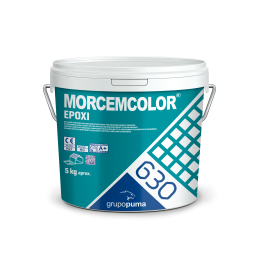
Epoxy antacid two-component mortar for laying and filling of ceramic tiles and mosaics with joints of width between 1 and 15 mm. Resistant to UV rays exposure and weather and climate action.



Informations supplémentaires
Technical Caracteristics
Epoxy mortar of two antacid components, where the part A is constituted by a mixture of resin epoxy, inert siliceous and additives, and the part B is constituted by catalysts of organic nature.
Advantages and Uses
- Easy application and cleaning even in comparison with the cementitious grouts for tiles.
- Stable and uniform colour in all types of tiles.
- Resistant to UV rays exposure and weather and climate action.
- High mechanical strength.
- Without absorption.
- It prevents the proliferation of moulds and fungus
- Total absence of cracks or fissures after the hardening.
- For antacid laying and filling in pavements and coverings, indoors and outdoors of ceramic tiles and glass mosaic with joints of 1 to 15 mm of width.
- Pavement joints with radiant heating.
- Foors and walls bathrooms and showers
- Cooking hobs, terraces and balconies.
- Optimal chemical resistance, suitable for surfaces exposed to aggressive chemicals, such as: dairies, breweries, butchers and food industries in general, advised also for filling joints in swimming pools, including thermal and saline water.
- The product can be used for ceramic tiles stucco in environments submitted to direct contact with food, as kitchens, slaughter houses, meat counters , fishes, lacteal, pastry shops, etc
- Suitable for stucking and landfilling of mosaic joints also in swimming pools with MORCEMDRY system.
Suitable Substrates
- The adhesive or mortar used for the laying of ceramic pieces must be completely dry and hardened.
- The joints must be dry and clean in its entire length and depth, being empty at least 2/3 of the thickness of the ceramic piece.
- The adhesive or mortar remains between joints must be eliminated
Application Procedure
- Cut the corner of the bag containing the component B and pour it entirety on the component A (dough). Mixe relation of 100 parts by weight of component A for 8 parts by weight of component B (wear gloves).
- Mix the two components through agitation with a drill with a spiral agitator until to get a homogeneous mixure without lumps.
- Scratch with a spatula or trowel the walls and the bottom of the container mixture to avoid product residues without reacting.
- Partial mixtures mustn´t be realized.
- The obtained product from the mixture may work for approx. 1 hour at a temperature of 23° C.
- Refill the joints with a rubber trowel, it is necessary to compact the product firmly, applying it in diagonal sense of the joints and removing the excess of product with the same rubber trowel.
- The workability and hardening time of the product is greatly influenced by the ambient temperature, the ideal temperature application is between + 18° C to + 23° C. In these conditions the workability time will be 1 hour and the traffic will be possible after 24 hours, but if the temperature is + 15° C we will need three days to circulate.
- The pavement commissioning with chemical attacks is possible after 5 days at temperatures of + 23 ° C and after 10 days at temperatures of + 15 ° C.
- With temperatures between + 8° C and + 12° C the product is very consistent and difficult to apply and the hardening time is greatly extended. Please do not add water or solvents to improve its workability.
- At very high working temperatures, it is suitable to apply the product quickly in order to reduce the working time from the reaction heat of that it can happen in the joints.
- The Cleaning and finishing will be done when the product would still be fresh and in the shortest possible time , taking care to not empty the joints and without leaving veils on the surface of the ceramic pieces.
- Spread manually, clean water on the tiles surface , the first cleanliness using a trowel with a white wet felt, doing circular movements in hourly and anti-hourly sense, to seal perfectly the sides of the ceramic pieces and removing the excess of product that stays on the ceramic pieces. Later do it a second times with a rigid sponge (type sweepex) to obtain a joint with smooth and firm surface, removing totally the product of the ceramic pieces taking care to not empty the joint and drying the excess water, to avoid leaving residual veils on the ceramic pieces.
- When felt and sponge are impregnated of resin and the cleaning is no longer possible, they must be replaced.
- Another method of cleanliness is with a monobrush, once it has been taken the joint excess of the ceramic surface, spreads water on the grouted surface and the cleanliness is done with a monobrush equipped with felt. Replace the felt disc when this one is impregnated with product.
- If there were any transparent veils on the ceramic surface, they can be eliminated after 24h or after the joint hardening (depending on the temperatures), using DESMOR EPOXI (consult its technical sheet for its correct use).
- It is also suitable for the bonding of glass and ceramic mosaics of any absorption and of small format (not exceeding 12 x 24.5 cm)on wall and floor surfaces.
- When it is used as adhesive, it is classified R2T according to Norm UNE EN 12004
- Apply the dough in the support with a suitable notched trowel and lay the ceramics with pressure.
Recommendations
- Apply preferably the product with temperatures between +18 ºC and +23ºC. Avoid to apply in low temperatures conditions or high environmental dampness to avoid the superficial carbonation formation that might alter the color uniformity
- Remove immediately the excessive parts of product of the ceramics surface because when it hardens, it will be only possible to remove it mechanically, with serious risks for the final work result.
- Mix the two components (A + B) properly.
- Change frequently the wash water.
- Change frequently the felt and the sponge if they are impregnated with product.
- Do not tread on the newly applied surface to avoid staining the pavement with resin residues.
- The product can´t be applied on very porous pieces as for exemple. Fired clay or cement ground.
- Do not cover with fabrics or other materials recently applied to prevent the condensation formation that would result from the superficial carbonation product altering its uniformity color.Wait about 24-48 hours depending on the temperature before protecting the surface.
- In the case that the application is on natural stone, it is indispensable to do a preliminary test to verify the possible absorption of epoxy resin on slabs. If it happens a darker veil on the surface and sides of slabs would appear and it couldn´t be removed. This problem occurs in general in clear color of marbles.
- The product cannot be used on surfaces where there are confined chemical aggressive substances admitted only for intermittent contact (see chemical resistance tables).
- Do not mix the product with water or solvents.
- With ceramic tiles pressed by compaction and with a similar surface of wood it can be difficult to remove the spots. In this case , it is recommended to do a previously test or to consult to the technical department.
- Do not use the product for applications not listed in this technical data sheet.
Resistance to chemicals chart
|
(The included table, is a synthesis of chemical resistance tests realized in according to the norm UNE EN 12808-1)
CHEMICAL RESISTANCE OF COATINGS CERAMIC WITH MORCEMCOLOR EPOXY BOARD ROOM DESTINATION FLOOR
|
|||||||
| Group | Name | Conc. % | CONTINUOUS SERVICE | INTERMITTENT SERVICE | |||
| 24 h | 7 days | 14 days | 28 days | ||||
| Ácidos | Acetic acid | 2.5 | I | I | I | I | I |
| 5 | I | I | I | G | I | ||
| Hydrochloric acid | 37 | I | I | I | G | I | |
| Citric acid | 10 | I | I | I | I | I | |
| Lactic acid | 2.5 | I | I | I | I | I | |
| 5 | I | I | I | I | I | ||
| 10 | I | I | I | I | I | ||
| Nitric acid | 25 | I | I | I | I | I | |
| 50 | I | L | L | L | I | ||
| Pure Oleic acid | - | I | L | L | L | I | |
| Sulfuric acid | 1.5 | I | I | I | I | I | |
| 50 | I | I | I | I | I | ||
| 96 | L | L | L | L | L | ||
| Tannic acid | 10 | I | I | I | I | I | |
| Tartaric acid | 10 | I | I | I | I | I | |
| Oxalic acid | 10 | I | I | I | I | I | |
| Group | Name | Conc. % | CONTINUOUS SERVICE | INTERMITTENT SERVICE | |||
| 24 h | 7 days | 14 days | 28 days | ||||
| Alkalis | Amoniaco en soluc. | 25 | I | I | I | I | I |
| Caustic soda | 50 | I | I | I | I | I | |
| Sodium hypochlorite in Sun: conc. Active CL | >10 | I | I | I | G | I | |
| Potassium hydroxide | 50 | I | I | I | I | I | |
| Sodium bisulfite | 10 | I | I | I | I | I | |
| Group | Name | Conc. % | CONTINUOUS SERVICE | INTERMITTENT SERVICE | |||
| 24 h | 7 days | 14 days | 28 days | ||||
| Solutions saturated at 20ºC | Sodium hyposulfite | I | I | I | I | I | |
| Calcium chloride | I | I | I | I | I | ||
| Sodium chloride | I | I | I | I | I | ||
| Iron chloride | I | I | I | I | I | ||
| Sugar | I | I | I | I | I | ||
| Group | Name | Conc.% | CONTINUOUS SERVICE | INTERMITTENT SERVICE | |||
| 24 h | 7 days | 14 days | 28 days | ||||
| Oils and fuels | Gasoline | I | I | I | G | I | |
| Turpentine | I | I | I | I | I | ||
| Diesel | I | I | I | I | I | ||
| Virgin olive oil | I | I | I | I | I | ||
| Lubricating oil | I | I | I | I | I | ||
| Group | Name | Conc. % | CONTINUOUS SERVICE | INTERMITTENT SERVICE | |||
| 24 h | 7 days | 14 days | 28 days | ||||
| Solvents | Acetone | I | L | L | L | I | |
| Ethylene glycol | I | I | I | I | I | ||
| Glycerin | I | I | I | I | I | ||
| Ethyl alcohol | I | I | G | L | I | ||
| Solvent Petrol | I | I | I | I | I | ||
| Oxygenated water | 10 | I | I | I | I | I | |
| 25 | I | I | I | I | I | ||
|
LEGEND:
|
| If this information contained in this technical data sheet are the result of our experience, they also have an indicative value. Every specific case must be submitted to preliminary practical tests by the user that assumes the final responsibility of the work. |
Consumption according to dimensions (kg/m²)
| TILE FORMAT (mm) |
JOINT WIDTH (mm)
|
||||||
|
1,5
|
2
|
3
|
4
|
5
|
7
|
10
|
|
| 25x25x3 | 0,56 | 0,74 | 1,12 | 1,49 | 1,86 | 2,60 | 3,72 |
| 50x50x4 | 0,37 | 0,50 |
0,74
|
0,99
|
1,24
|
1,74
|
2,48
|
| 50x50x8 | 0.74 | 0,99 |
1,49
|
1,98
|
2,48
|
3,47
|
4,96
|
| 100x100x8 | 0,37 | 0,50 |
0,74
|
0,99
|
1,24
|
1,74
|
2,48
|
| 125x24x12 | 0,34 | 0,45 |
0,68
|
0,91
|
1,13
|
1,58
|
2,26
|
| 150x150x6 | 0,19 | 0,25 |
0,37
|
0,50
|
0,62
|
0,87
|
1,24
|
| 150x150x8 | 0,25 | 0,33 | 0,50 | 0,66 | 0,83 | 1,16 | 1,65 |
| 200x200x8 | 0,19 |
0,25
|
0,37 | 0,50 | 0,62 | 0,87 | 1,24 |
| 250x330x8 | 0,13 | 0,17 | 0,26 | 0,35 | 0,44 | 0,61 | 0,87 |
| 300x300x8 | 0,12 | 0,17 | 0,25 | 0,33 | 0,41 | 0,58 | 0,83 |
| 300x600x8 | 0,09 | 0,12 | 0,19 | 0,25 | 0,31 | 0,43 | 0,62 |
| 400x400x8 | 0,09 | 0,12 | 0,19 | 0,25 | 0,31 | 0,43 | 0,62 |
| 450x450x8 | 0,08 | 0,11 | 0,17 | 0,22 | 0,28 | 0,39 | 0,55 |
| 600x600x10 | 0,08 | 0,10 | 0,16 | 0,21 | 0,26 | 0,36 | 0,52 |
| 600x1200x10 | 0,06 | 0,08 | 0,12 | 0,16 | 0,19 | 0,27 | 0,39 |
| 1000x1000x10 | 0,05 | 0,06 | 0,09 | 0,12 | 0,16 | 0,22 | 0,31 |
| CONSUMPTION AS ADHESIVE |
Notched trowel of 4 mm, consumption: 1.6 kg/m2
|
||||||
* Consumption calculated for empty joint, without adhesive residue.
**For the calculation of consumption of any other format, use the following formula: (A+B)/(AxB) x C x D x
0,155 = kg/m2
Where:
A = Width of tile (cm)
B = Tile length (cm)
C = Thickness of the tile (mm)
D =Seam width (mm)
Packaging and Storage
Plastic container of 5 kg Bi-component on pallet of 450 kg. Storage up to 24 months in its original closed packing and without overturning, sheltered by the wheather and the dampness.
Technical data
(Statistical results in standard conditions)
| APPLICATION DATA | |
| Waiting time for its application | Put on the pavement
- Normal adhesive: 24 hours
- With rapid adhesive: 4 hours
- Mortar: 7-10 days
Put on the cladding
- Normal adhesive: 6-8 hours
- With rapid adhesive: 4 hours
- Mortar: 2-3 days
|
| Mixing relation |
Component A: 100 parts by weight
Component B: 8 parts by weight
|
| Mixure Consistency | Pasty |
| Dough Life time | Approx. 1 hour t = + 23° C |
| Permitted application temperature | From + 12 ° C to + 30 ° C |
| Preferred application temperatures | From + 18° C to + 23° C |
| Passability | 24-hour t = + 23° C |
| Commissioning time | 5 days in T = + 23° C |
| Width of joints | 1 to 15 mm |
| PERFORMANCES SUCH AS ADHESIVE | |
| Adherence to the initial cut 12003 | ≥ 2 N / mm2 |
| Adherence to the cut after water immersion EN 12003 | ≥ 2 N / mm2 |
| Adherence to the cut after heat shock EN 12003 | ≥ 2 N/mm2 |
| Classification according to UNE-EN 12004 | R2T |
| PERFORMANCES AS GROUTING | |
| Resistance to abrasion (EN 12808-2) | ≤ 250 mm3 |
| Resistance to flexion after 28 days (EN 12808-3) | ≥ 30 N/mm2 |
| Resistance to compression after 28 days (EN 12808-3) | ≥ 45 N/mm2 |
| Retraction (EN 12808-4) | ≤ 1,5 mm/m |
| Water absorption after 4 hours (EN 12808-5) | ≤ 0,1 g |
| Working temperature | From -20 °C to + 100 °C |
| Classification according to UNE-EN 13888 | RG |
| DATOS DE IDENTIFICACIÓN | ||
| Appearance | Component A: colored dense dough | Component B: dense liquid |
| Colors available | White EP 154 | |
| Beige EP 172 | ||
| Grey EP 157 | ||
| Dark grey EP 156 | ||
| Brown EP 189 | ||
| Customs classification | 35069100 | |