 Paviland® SL10
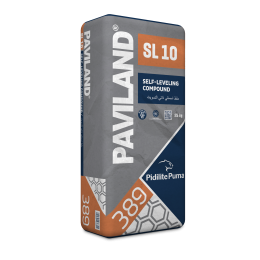
Self-levelling floor coating compound for interior residential floors that once harden accepts any kind of pavements: ceramic, parquet, etc. 2mm to 10 mm thickness. Self-levelling compund for levelling irregular pavements indoors. High mechanical resistance. Easy to lay and high self-levelling power.

Additional information
Technical Characteristics
Product based on cements, selected aggregates and additives.
Advantages and Uses
- Irregular pavements levelling in interior areas.
- High mechanical resistance.
- Easy to apply
- High self-levelling capacity.
- Floors' smoothing in residential areas with moderate pedestrian traffic, before placing the final pavement: ceramic, parquet, PVC, linoleum, etc.
Suitable Substrates
- Concrete, cementitious floorings or substrates with a suitable resistance or similar stregth. In case of working with other substrates, please consult our technical department.
- Substrates must be resistant, stable, sound, and clean, free from dust or any other kind of substances, organic products, etc.
- If necessary prepare the substrate mechanically so that the surface if free from grout and has the appropriate porosity.
- Before applying PAVILAND SL 10, any possible hollows and cracks should be adequately repaired using the PAVILAND or MORCEMREST adequate product, according to the nature of the substrate and the type of reparation required.
- Apply Paviland Primer R to avoid the formation of air bubbles in the cladding and in order to improve its adherence to the substrate according to the instructions given in the technical data sheet of the product.
- Before applying the mixed product, ensure that the residual humidity is below the recommended level (lower than 3%).
Application Procedure
- Mix the product with water (5.5 - 5.8 L per each 25 Kg bag), with a mechanic mixer at low speed (500 rpm approximately) until getting a homogeneous paste without lumps. It is essential to add the exact specified amount of water in order to avoid the segregation of the product, high retractions and a decrease in resistance.
- Let the mixture settle for 2 minutes and remix.
- The paste should be used during the following 30 minutes after it has been prepared, this, of course, will depend on environmental conditions as well.
- Pour the mixed product on top of the substrate and spread it with a levelling trowel.
- The maximum thickness suggested would be around 10mm thickness applying it in just one layer.
- Respect the structural joints and carry out perimeter and partition joints.
- PAVILAND SL 10 must be protected, as it is not an appropriate material to remain uncovered.
Recommendations
- Application temperature range from 5ºC to 40ºC.
- Do not apply when there is a risk of frost, strong wind or direct sun weather conditions
- Not recommended for exterior use Do not apply on floors with humidity or that may suffer from it in the future.
- Do not add any aggregates, cement nor any type of product that may modify the original formula.
- Once the product has been mixed and its resting time has passed, do not add any more water.
- For floors larger than 20 m2 or longer than 10 lineal metres, it is advisable to make partitioning joints, delimiting panels with 6 mm joints that can be sealed with PUMALASTIC MS or PU.
- Movement joints on the original substrate must be respected and permiteral joints made.
- The surface coat should be protected against an extremely fast drying, specially under high temperatures or heavy winds conditions.
- Before placing the final pavement, you should check the residual humidity of the floor and confirm it is adequate for the type of flooring to be installed.
Packaging and Storage
25kg laminated paper bags.
1 year storage in its original packaging, away from extreme weather conditions and humidity.
Technical data
(Statistic results were obtained under standard conditions).
| Aspect | Grey powder |
| Pot life | 30 minutes |
| Adherence to concrete | >1 N/mm2 |
| Set to light foot traffic | 8– 12 hours |
| Sanding time (*) | 12– 24 hours |
| Waiting time before subsequent bonding | Ceramic or carpet: 12-24 hours |
| Parquet or synthetic cladding: 24-48 hours | |
| Compression strength | > 5 N/mm2 (1 d) |
| > 15 N/mm2 (7 d) | |
| > 20 N/mm2 (28 d) | |
| Approximate yield | 1.5 Kg/m2 and mm thickness |
| Classification according to UNE EN 13813 | CT C20 F6 |
| Application thickness: | from 2 to 10 mm |
Notas
The information and instructions in this datasheet are based on our current tests and technical knowledge. They are intended as general guidance and do not constitute a binding commitment by PIDILITEPUMA MEA CHEMICALS LLC. It is the sole responsibility of the user to verify, prior to use, that the product is suitable for the intended application and to ensure that it is applied correctly and in accordance with applicable regulations and good industry practice.
PIDILITEPUMA MEA CHEMICALS LLC cannot control how its products are applied on site throughout the entire project and therefore cannot accept responsibility for their application by contractors or other parties involved in the execution of the work. Support visits to the jobsite by our technical staff do not change that. Our responsibility is limited exclusively to defects that can be directly attributed to the supplied products, whether used individually or as part of a system, caused by manufacturing defects.
It is the responsibility of the project designer, site manager, contractor, or other relevant professionals to ensure that the selected products are appropriate for the specific project, taking into account their properties, the substrate, site conditions, and any existing issues.
In the event of a claim, the original packaging must be provided to ensure proper product traceability.
Any performance values stated for PIDILITEPUMA MEA CHEMICALS LLC products or construction solutions, whether in UNE standards or other applicable standards, are based solely on the specific test conditions defined in those standards (such as substrate type, temperature, and humidity). These values may not apply to situations where products are tested or used under different conditions.