 Traditerm® Ceramic
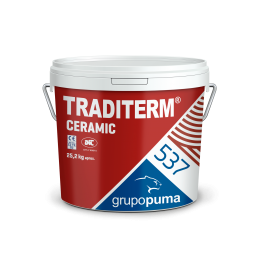
Two-component high-performance adhesive for applying ceramic in the TRADITERM CERAMIC (SATE/ETICS) System, certified with DIT (technical approval) No. 605R/20. No sagging and excellent initial adhesion. It has a high open time, allowing the rectification of parts. This adhesive mortar for insulation systems is highly deformable
Additional information
Technical Characteristics
Two-component product composed of mineral binders, selected aggregates, and resins in dispersion.
Advantages and Uses
- Ceramic application over TRADITERM CERAMIC (SATE/ETICS) System.
- Product certified in accordance with DIT No. 605R/20, for installing ceramic over the TRADITERM CERAMIC (SATE/ETICS) System
- Non-slip. Excellent initial bonding.
- Long open time, allows for the repositioning of tiles.
- Highly Deformable. Type S2.
Suitable Substrates
- External thermal insulation system TRADITERM CERAMIC (SATE/ETICS).
- The base coat of the system to be treated with ceramic, must have been previously cured for at least 48 hours.
- In case of hot or windy weather conditions it is advisable to wet the substrate and wait until the thin layer of water disappears.
Application Procedure
- At least 48 hours after applying the last Traditerm mortar base coat, the ceramic is applied to the system with TRADITERM CERAMIC adhesive.
- The TRADITERM CERAMIC adhesive product consists of two components: a bag of mortar and a container of liquid resin, which must be mixed mechanically in its entirety without any other additives, until a uniform consistency has been obtained.
- Let the mixture stand for 5 minutes and remix.
- Spread the mixed product onto the substrate (TRADITERM CERAMIC (SATE/ETICS) System) with a trowel to a maximum surface area of 1 m2.
- Spread with a notched trowel to adjust the thickness (see chart).
- With the aid of a trowel, spread the product over the surface of the ceramic tile (using the double bonding technique).
- Lay the tiles, pressing and moving them to ensure total and correct adhesion to the grooves and correct adhesion with the entire surface.
- Respect the construction joints:
- Expansion Joints.
- Partitioning Joints – Carry out every 3 vertical metres and 4 horizontal metres. Subsequently seal with the Pumalastic Range.
- Joints between tiles – Minimum thickness of 4 mm. After at least 24 hours after fixing the tiles, grout with the Morcem Colour Plus Range.
Notched-trowel panel
Maximum tile weight with the TRADITERM CERAMIC System: 22 kg/m²
|
TILE FORMAT |
NOTCHED TROWEL | BONDING |
| < 100 cm2 | U4 (4 x 4 x 4) | Single |
| < 450 cm2 | U6 (6 x 6 x 6) | Single |
| < 900 cm2 | U6 (6 x 6 x 6) / U9 (9 x 9 x 9) or n10 | Double - Single |
Recommendations
- Do not apply under 5ºC nor above 30ºC.
- Do not apply when there is a risk of frost, rain, strong wind or direct sunlight.
- In extreme weather conditions (strong winds or hot temperatures) drying may occur faster than normal.
- The mortar and resin kit supplied must be fully mixed to achieve the product's performance.
- For best results lay tiles as soon as possible after spreading.
- The double bonding technique should be used for fixing ceramic tiles.
- Do not install ceramic tiles higher than 30 metres with the Traditerm Ceramic (SATE/ETICS) System. Please consult our technical department for heights above 30 metres.
Main Characteristics of the ceramic to be used:
- The maximum tile format is 300 x 300 mm x 10 mm
- Maximum weight of the tiles: 22 kg/m²
- Groups I and II in accordance with EN-14411
Packaging and Storage
The kit contains: powder product in 20 kg laminated paper sacks + resin dispersion in 5.2 kg plastic packages.
Shelf life: 1 year in sealed original packaging, sheltered from weather conditions and humidity.
Technical data
(Statistical data obtained under standard conditions)
| Appearance | WHITE powder |
| Apparent density of powder | 1.6 ± 0.2 g/cm³ |
| Open time | Approx. 30 mins. (depending on weather conditions) |
| Adjustment time | Approx. 30 mins. (depending on weather conditions) |
| Paste open time | Approx. 2 hours. (depending on weather conditions) |
| Initial adhesion | > 2.0 N/mm² |
| Adhesion after immersion | > 1.0 N/mm² |
| Adhesion after heat ageing: | > 1.5 N/mm² |
| Adhesion after freeze/thaw cycles | > 1.0 N/mm² |
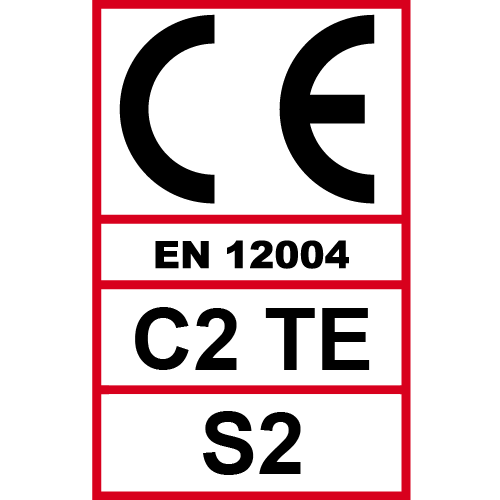
| Classified according to UNE EN 12004:2008: | C2TE |
| Classified according to UNE NE 12002:2009: | S2 |
| Product Certified in accordance with DIT Nº 605R/20 | |
| Performance | Approx. 5-8 Kg/m² (Double Bonding and according to notched trowel size) |
Notas
The information and instructions in this datasheet are based on our current tests and technical knowledge. They are intended as general guidance and do not constitute a binding commitment by PIDILITEPUMA MEA CHEMICALS LLC. It is the sole responsibility of the user to verify, prior to use, that the product is suitable for the intended application and to ensure that it is applied correctly and in accordance with applicable regulations and good industry practice.
PIDILITEPUMA MEA CHEMICALS LLC cannot control how its products are applied on site throughout the entire project and therefore cannot accept responsibility for their application by contractors or other parties involved in the execution of the work. Support visits to the jobsite by our technical staff do not change that. Our responsibility is limited exclusively to defects that can be directly attributed to the supplied products, whether used individually or as part of a system, caused by manufacturing defects.
It is the responsibility of the project designer, site manager, contractor, or other relevant professionals to ensure that the selected products are appropriate for the specific project, taking into account their properties, the substrate, site conditions, and any existing issues.
In the event of a claim, the original packaging must be provided to ensure proper product traceability.
Any performance values stated for PIDILITEPUMA MEA CHEMICALS LLC products or construction solutions, whether in UNE standards or other applicable standards, are based solely on the specific test conditions defined in those standards (such as substrate type, temperature, and humidity). These values may not apply to situations where products are tested or used under different conditions.