 Traditerm® Proyectable
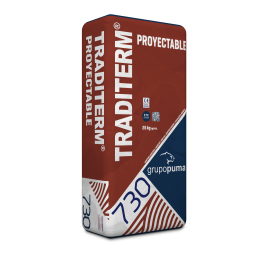
Single-component white mortar with extraordinary adhesion to polystyrene and exceptionally low capillary water absorption. Designed for application as an adhesive for expanded polystyrene insulation panels (Traditerm Panel EPS), graphite expanded polystyrene (Traditerm Panel EPS-G), mineral wool (Traditerm Panel MW), and natural cork (Traditerm Panel Corcho) and as a reinforced render for these materials. It supports finishes from the Morcemcril range and Morcemdur ITE mortar. It can be applied for the renovation of façades, as a reinforced base coat on render or cement-based screed substrates. For this application, the finish will be from the Morcemcril range. Applicable by hand or by spraying.


Additional information
Technical Characteristics
Product based on white cement, air lime, selected limestone aggregates, lightweight aggregates, enhancing additives, and powdered resins.
Advantages and Uses
- Multi-purpose: Use as an adhesive for panels, reinforced rendering for the same, and as a finish.
- Great adhesion and cohesion.
- Excellent workability.
- Exceptionally low permeability to rainwater. Highly permeable to water vapour.
- Total resistance to ageing, even when subjected to the hygrothermal cycles of thermal insulation.
Suitable Substrates
- Only the following vertical substrates are acceptable:
- All types of ceramic walls, including lightweight (“Termoarcilla”), normal or lightweight concrete blocks (“cellular”).
- Smooth concrete.
- Renders or screeds based on cement, other single-coat mortars in good condition.
- Expanded polystyrene.
- Neither TRADITERM PROYECTABLE mortar nor the complete SYSTEM can be applied on horizontal substrates facing upwards or on walls inclined more than 10º from the vertical unless they have a rain protection cover.
- The substrates must be clean and sound, damp but not saturated with moisture. They must be sufficiently strong, stable, and free from dust or remnants of products that could impair adhesion, such as gypsum, form-release agents, or paints.
- All substrates must be adequately flat with deviations not exceeding 1 cm (measured with a 2 m rule). If not, they must be corrected 24 hours in advance with any of the mortars suitable as a substrate for the system.
Application Procedure
Previously prepare the substrate, apply the primer IMPLAFIX or TEXTUREFIX PLUS to the low-absorbent surfaces (concrete) and fix the base profile.
Mixing with a low rpm mixer:
Mechanically mix the mortar with approximately 5.0-5.5 litres of clean water per bag until a homogeneous, lump-free paste is obtained. Let it rest for a couple of minutes and remix.
Mechanical mixing with a mixing and spraying machine:
- Continuous: Adjust the water flow so that the mortar initially comes out more fluid and then reduce it until the appropriate consistency is achieved. Keep it constant throughout the application.
- Discontinuous: Pour the corresponding water into the mixing tub (approximately 5.0-5.5 litres of water per bag), progressively add the corresponding mortar bags, and once all have been added, mix for about 5 minutes until a homogeneous, lump-free paste of the appropriate consistency is obtained. It is good practice to start mixing with 5% less water than the theoretical amount and add the necessary amount once all the bags are added. t is good practice to start mixing with 5% less water than the theoretical amount and add the necessary amount once all the bags are added.
Use as an adhesive for panels:
Using a notched trowel (For substrates with good flatness):
- Spread the mortar over the surface of the panel.
- Adjust the thickness with a notched trowel of at least 10 mm.
- Remove the mortar in a strip 2 cm around the board.
Using the “cord” mortar method:
- Spread the mortar by hand, with a trowel, or by machine in a rectangular cord, parallel to the perimeter and about 2 cm from the edge of the board. Leave some openings, do not form a closed rectangle.
- Inside the rectangle, place three “blotches” of mortar about 10-15 cm in diameter and about 1 to 2 cm high.
Fixing the panels:
Once the mortar is placed on the back of the board by any of the described methods and before it loses its stickiness, apply it in the intended place, press lightly by hand and more intensely with a trowel until it is perfectly aligned and adjusted with the profiles and the surrounding panels.
Use as rendering for panels:
At least 24 hours after fixing, and having already installed the mechanical fasteners, install the reinforcement profiles in the corners and remove burrs and unevenness among the panels with a sander.
Apply a coat of mortar over the boards mechanically or with a trowel and “comb” it with an 8 mm square trowel. Fully embed the reinforcing TRADITERM MALLA in this coat so that there is an overlap of at least 10 cm between vertical strips and the reinforcement strips in the corners of all openings.
Before it has set, apply a new coat of TRADITERM PROYECTABLE mortar until a minimum total thickness of 4 mm is reached. This layer can be smoothed if the finish is to be a fine render (such as MORCEMCRIL) or combed with an 8 mm notched trowel slightly inclined, leaving horizontal grooves when covered with the MORCEMDUR ITE finish.
Recommendations
- Do not apply, without taking appropriate protective measures, at temperatures below 5ºC or above 30ºC, in strong wind or direct sunlight.
- Do not use if frost or heavy rain is expected in the next 24 hours.
- It is not recommended to use it on horizontal surfaces or those inclined more than 10º from the vertical in uncovered exteriors.
- Respect the structural joints of the buildings.
- Protect the top of the render as soon as possible to prevent rainwater ingress.
Packaging and Storage
25 kg laminated paper sacks.
Storage up to 12 months in its original closed packaging, protected from weather and moisture.
Technical data
(Results obtained under standard conditions)
| Aspect | White powder |
| Bulk density of powder | 1.300 ± 100 (kg /m3) |
| Density of mixed product | 1.600 ± 100 (kg /m3) |
| Hardened density | 1.400 ± 100 (kg /m3) |
| Classification according to UNE EN 998-1 | GP |
| Water absorption | W2 |
| Fire reaction | A1 |
| Water vapour permeability ( µ ) | ≤ 15 |
| Thermal conductivity (λ) | 0.35 + 0.05 W/Mk |
| Adhesion on concrete terrazzo | ≥ 0,8 N/mm2 |
| Adhesion on polystyrene panel | ≥ 0,8 N/mm2 |
Product performance
| Coat | Application Technique | Minimum application thickness | Performance |
| Adhesive | Spot bonding - Notched Trowel | According to substrate condition and flatness | 5-10 kg/m2 depending on flatness |
| Panels rendering | 8 mm notched trowel | 4 mm | Approx. 1.6 kg/m2/mm |
Environmental Product Declaration (EPD)
Mortar made with aggregates close to production centres reducing greenhouse gas emissions associated with its transport and manufactured in production centres with Environmental Management Systems certified according to ISO 14001, a firm commitment to sustainability and environmental respect.
Mortar with type III eco-label (the most demanding) Environmental Product Declaration externally verified by AENOR.
Notas
The information and instructions in this datasheet are based on our current tests and technical knowledge. They are intended as general guidance and do not constitute a binding commitment by PIDILITEPUMA MEA CHEMICALS LLC. It is the sole responsibility of the user to verify, prior to use, that the product is suitable for the intended application and to ensure that it is applied correctly and in accordance with applicable regulations and good industry practice.
PIDILITEPUMA MEA CHEMICALS LLC cannot control how its products are applied on site throughout the entire project and therefore cannot accept responsibility for their application by contractors or other parties involved in the execution of the work. Support visits to the jobsite by our technical staff do not change that. Our responsibility is limited exclusively to defects that can be directly attributed to the supplied products, whether used individually or as part of a system, caused by manufacturing defects.
It is the responsibility of the project designer, site manager, contractor, or other relevant professionals to ensure that the selected products are appropriate for the specific project, taking into account their properties, the substrate, site conditions, and any existing issues.
In the event of a claim, the original packaging must be provided to ensure proper product traceability.
Any performance values stated for PIDILITEPUMA MEA CHEMICALS LLC products or construction solutions, whether in UNE standards or other applicable standards, are based solely on the specific test conditions defined in those standards (such as substrate type, temperature, and humidity). These values may not apply to situations where products are tested or used under different conditions.