 Morcemrest® C5 R3
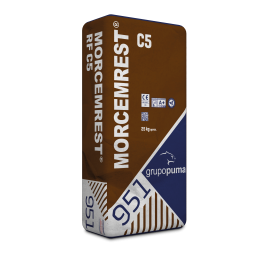
Single-component R3 cosmetic repair and surface levelling mortar.

Additional information
Technical Characteristics
Product based on special cements, synthetic resins, and silica fume.
Advantages and Uses
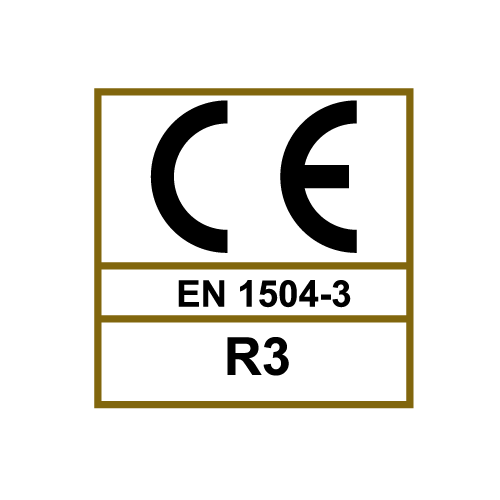
- R3 type repair mortar according to EN-1504-3.
- Excellent adhesion.
- Excellent reshaping properties.
- Particularly good compatibility with concrete.
- It is water and weather resistant.
- Repair and levelling of damaged surfaces of concrete on structures, pillars, or façades.
- Surface and cosmetic repair of prefabricated pieces of all kinds.
- Sealing of pores for concrete or mortar substrates.
- Levelling of concrete surfaces.
- Fine renders on concrete, masonry walls, mortars.
Suitable Substrates
- Substrates must be resistant enough, stable, sound, and clean. Free of dust, release agents, organic products, etc.
- Absorbent substrates will be previously moistened until saturation, avoiding puddles.
Application Procedure
Mixing the mortar:
- Add 2/3 of water and progressively add the powder while stirring. Then add the rest of the water and mix for two more minutes. Do not prepare more material than the one to be used in 30 minutes (at +2ºC).
Application:
- Apply 2 to 5 mm thick coats of MORCEMREST C 5 with a trowel or spatula. Let it rest partially, before applying the finish coat.
Curing:
- Protect against wind, sun, and sun during hardening. To prevent excessive drying, it is advisable to cover the surface with damp sackcloth or plastic during the curing process.
Recommendations
- Do not add more water than recommended to the mortar and do not remix.
- Do not apply the product under 5ºC nor above 30ºC temperature.
- Do not add cement, sand, or other substances that may affect the properties of the material.
- The tools and equipment should be cleaned with solvent immediately after use to prevent the material from hardening, which will need to be removed by mechanical means.
- Do not apply more than 5 mm thickness.
- In manual applications, compact strongly between coats; in areas where compacting is difficult, we recommend application using mechanical processes.
- For further information regarding the preparation of concrete or steel reinforcements, please refer to the recommendations provided by standard UNE – EN – 1504 – 10.
Packaging and Storage
MORCEMREST C 5 is supplied in 25 Kg laminated paper sacks.
Store up to 1 year in its original closed container, away from extreme weather conditions and humidity.
Technical data
(Resultados estadísticos obtenidos en condiciones estándar)
| REQUERIMIENTOS R3 | DATOS DEL PRODUCTO | |
| Aspecto | Polvo GRIS | |
| Densidad de la pasta | Aprox. 1,90±0,1 gr/cm³ | |
| Granulometría | Dmax 0.2 mm | |
| Espesor de capa | 2 mm mín. 5 mm máx. |
|
| Resistencia a compresión 28 días (EN 12190) | ≥ 25 N/mm2 | ≥ 25 N/mm2 |
| Contenido en cloruros (EN 1015) | ≤ 0,05% | ≤ 0,01% |
| Adhesión (EN 1542) | ≥ 1,5 N/mm² | ≥ 1,5 N/mm² |
| Resistencia a la Carbonatación (EN 13295) |
dk ≤ hormigón de control tipo MC (0,45) | Pasa |
| Módulo de elasticidad (EN 13412) | ≥ 15 GPa | ≥ 15 GPa |
| Absorción capilar (EN 13057) | ≤ 0,5 kg / m² x h½ | ≤ 0,3 kg / m² x h½ |
| Ciclos Enfriamiento brusco a partir de Temperatura Elevada (EN 13687-2) | ≥ 1,5 N/mm² | ≥ 1,5 N/mm² |
| Compatibilidad térmica parte 4: Ciclos Térmicos en seco (EN 13687-4) |
≥ 1,5 N/mm² | ≥ 1,5 N/mm² |
|
CURVA RESISTENCIAS 7 días 28 días |
≥ 15 N/mm² ≥ 25 N/mm² |
|
Flexotracción (EN 12190) 28 días |
≥ 7 N/mm² | |
| Agua de amasado | 22±1% | |
| Rendimiento | 2 Kg./m²/mm espesor | |
|
Clasificación según EN 1504-3:2006 TIpo |
R3 CC |
CE Mark
 |
|
|
GRUPO PUMA ESPAÑA SL Avd. Agrupación Córdoba, Núm.17 14014 (Córdoba) |
|
| EN-1504-3 MORCEMREST C-5 Mortero para reparación estructural del hormigón, tipo PCC, para nivelación superficial, para espesores entre 2 y 5 mm. (A base de cemento hidráulico polimerizado) |
|
| Resistencia compresión | Clase R3 |
| Contenido en iones cloruros | ≤ 0.05% |
| Adhesión | ≥ 1.5 MPa |
| Resistencia a la carbonatación | Pasa |
| Módulo de elasticidad | ≥ 15 Gpa |
| Compatibilidad térmica parte 2 y 4 | ≥ 1.5 MPa |
| Absorción capilar | ≤ 0.5 Kg/m2 h0.5 |
| Reacción al fuego | A1 |
Environmental Product Declaration (EPD)
Cement based mortar prepared with aggregates that are supplied close to the production center, which reduces the greenhouse gas emissions that would otherwise arise from their transport. Manufactured in production centers with an Environmental management certified system following ISO 14001 regulation, offering a firm promise of sustainability and respect for the environment.
Cement based mortar with type III ecological label (the most strict) Environmental Product Declaration verified externally by AENOR.
Notas
The information and instructions in this datasheet are based on our current tests and technical knowledge. They are intended as general guidance and do not constitute a binding commitment by PIDILITEPUMA MEA CHEMICALS LLC. It is the sole responsibility of the user to verify, prior to use, that the product is suitable for the intended application and to ensure that it is applied correctly and in accordance with applicable regulations and good industry practice.
PIDILITEPUMA MEA CHEMICALS LLC cannot control how its products are applied on site throughout the entire project and therefore cannot accept responsibility for their application by contractors or other parties involved in the execution of the work. Support visits to the jobsite by our technical staff do not change that. Our responsibility is limited exclusively to defects that can be directly attributed to the supplied products, whether used individually or as part of a system, caused by manufacturing defects.
It is the responsibility of the project designer, site manager, contractor, or other relevant professionals to ensure that the selected products are appropriate for the specific project, taking into account their properties, the substrate, site conditions, and any existing issues.
In the event of a claim, the original packaging must be provided to ensure proper product traceability.
Any performance values stated for PIDILITEPUMA MEA CHEMICALS LLC products or construction solutions, whether in UNE standards or other applicable standards, are based solely on the specific test conditions defined in those standards (such as substrate type, temperature, and humidity). These values may not apply to situations where products are tested or used under different conditions.