 Morcemrest® EF 50 R4
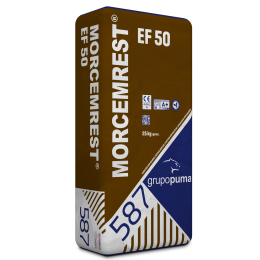
High resistance monocomponent R4 repair mortar for large thicknesses.

Additional information
Technical Characteristics
Product based on special cements, selected aggregates and additives, reinforced with fibres.
Advantages and Uses
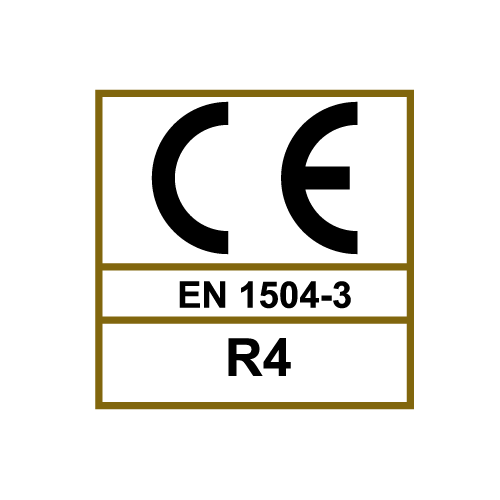
- Repair mortar class R4 according to EN-1504-3.
- High adherence to concrete and high modulus.
- Thixotropic, without sagging in ceiling applications.
- Water vapour permeable.
- Good chloride resistance.
- Resistant to freeze-thaw cycles.
- Joint filling between concrete sections, prefabricated elements and expansion joints.
- Shrinkage compensated to minimize risk of cracking.
- High resistance to carbonation.
- Weatherproof.
- Indoor and outdoor application.
- Repairs of structural elements such as columns, bridge girders, water treatment plants, tunnels, pillars with large load transfer.
- Concrete regeneration.
Suitable Substrates
- The substrate must be sound, clean, and free of grease, oil, dust and badly-bonded parts (minimum tensile strength of 1.5 MPa).
- If necessary, prepare the same preferably using mechanical means and leave the new concrete uncovered.
- The absorbent substrates should be previously wetted until they are saturated, preventing waterlogging, apply MORCEMREST EF 50 once the surface has a matt appearance.
- If there are reinforcements, they should be clean of rust, grease, oil and other badly-bonded particles.
- If they are rusty, they must be sandblasted or metal brushed. Protect from corrosion with IMPLAREST C.
- In vertical and horizontal wall joints, widen the joint by cutting it up to about 10 mm wide with a radial saw, removing the cut material afterwards.
Application Procedure
Mortar mix:
- Add the prepared 2/3 parts water and progressively mix all of the powder while stirring. Then add the remaining water and mix for another 2 minutes. Do not prepare more material than what you are going to use for 30 minutes. (a +20ºC).
Application:
- Apply MORCEMREST EF 50 with a trowel or projected with a gun, applying pressure to assure bonding and compact the material firmly.
- MORCEMREST EF 50 can be applied in a few layers, the minimum layer thickness being 5 mm. Applications of up to 50 mm can be made on vertical surfaces without the help of formworks. The maximum thickness for horizontal surfaces is 100 mm.
- Fill the joints completely
Curing:
- Protect from the wind, frost and sun during hardening. To prevent excessive drying out, it is recommended to cover the surface with wet hessians or plastic during curing.
- Observe protection procedures after application.
Recommendations
- Do not add more than the recommended amount of water and do not re-knead.
- Do not apply below 5ºC nor above 30ºC
- Do not add cement, sand or any other substance which will alter the product properties.
- Instruments and tools should be cleaned with water immediately after use to prevent material hardening, which has to be eliminated by mechanical means.
- Contact the Technical Department for any application not specified in this datasheet.
- For any information regarding the safe handling, transport, storage and use of the product please refer to the updated version of the Product Safety Datasheet.
- If applied manually ensure the coats are strongly compacted; in areas of difficult compaction it is recommended its mechanical application.
- For further information on how to prepare concrete or steel framework; consult the recommendations given by the UNE-EN-1504-10 guideline.
- When applying the repair mortar without a bonding bridge, the foundation of concrete must be rough, clean and well moistened before, but the surface must be free of water at the time of application, that is, the foundation must not be waterlogged. The repair mortar must be applied making it penetrate into the foundation previously prepared and must be compacted avoiding the inclusion of air in order to obtain the required strength, and to protect the reinforcement from corrosion.
Packaging and Storage
MORCEMREST EF 50 comes in bags of 25 Kg of powder.
Shelf life: 1 year in sealed original packaging, sheltered from weather conditions and humidity.
Technical data
(Statistical data obtained under standard conditions)
| R3 REQUIREMENTS | PRODUCT DATA | |
| Aspect | GREY powder | |
| Density of paste | Aprox. 2.0 ± 0,1 gr/cm³ | |
| Granulometry | Dmax 2 mm | |
| Coat thickness |
5 mm min. 50 mm max. |
|
| Resistence to compression 28 days (EN 12190) | ≥ 45 N/mm² | ≥ 50 N/mm² |
| Chloride content (EN 1015) | ≤ 0,05% | ≤ 0,01% |
| Adhesion (EN 1542) | ≥ 2 N/mm² | ≥ 2 N/mm² |
| Resistance to carbonation (EN 13295) | dk ≤ concrete control type MC (0,45) | Pass |
| Module of elasticity (EN 13412) | ≥ 20 GPa | ≥ 20 GPa |
| Capillarity absorption (EN 13057) | ≤ 0.5 kg / m² x h½ | ≤ 0.2 kg / m² x h½ |
| Thermal compatibility part 1 (EN 13687-1) | ≥ 2 N/mm² | ≥ 2 N/mm² |
| Sudden cooling cycle after high temperatures (50 cycles) (EN 13687-2) | ≥ 2 N/mm² | ≥ 2 N/mm² |
| Thermal compatibility part 4: Dry thermal cycle (50 cycles) (EN 13687-4) | ≥ 2 N/mm² | ≥ 2 N/mm² |
|
CURVE RESISTANCE Compression: (EN 12190) 1 day 7 days 28 days |
≥ 20 N/mm² ≥ 35 N/mm² ≥ 45 N/mm² |
|
|
Flexural strength (EN 12190) 28 days |
≥ 7 N/mm² |
|
| Life of mixed product | 20 - 30 minutes | |
| Water content in mixture | 15±1% | |
| Performance | 2.2 kg./m²/ mm thick | |
|
Classification complies to EN 1504-3:2006 Type |
R4 PCC |
CE Mark
 |
|
| GRUPO PUMA ESPAÑA SL Avd. Agrupación Córdoba, Núm.17 14014 (Córdoba) 23 Nº: 210306 |
|
|
0370-CPR-2578 EN-1504-3 Product for structurally repairing concrete with PCC mortar. For vertical |
|
| Resistance to compression | R4 Class |
| Chloride content | ≤ 0.05% |
| Adherence | ≥ 2 MPa |
| Resistance to carbonatation | Pass |
| Elasticity module | ≥ 20 GPa |
| Thermal compatibility part 1 | ≥ 2 MPa |
| Capillary absorption | ≤ 0.5 kg.m2h0.5 |
| Reaction to fire | A1 |
Environmental Product Declaration (EPD)
Cement based mortar prepared with aggregates that are supplied close to the production center, which reduces the greenhouse gas emissions that would otherwise arise from their transport. Manufactured in production centers with an Environmental management certified system following ISO 14001 regulation, offering a firm promise of sustainability and respect for the environment.
Cement based mortar with type III ecological label (the most strict) Environmental Product Declaration verified externally by AENOR.
Notas
The information and instructions in this datasheet are based on our current tests and technical knowledge. They are intended as general guidance and do not constitute a binding commitment by PIDILITEPUMA MEA CHEMICALS LLC. It is the sole responsibility of the user to verify, prior to use, that the product is suitable for the intended application and to ensure that it is applied correctly and in accordance with applicable regulations and good industry practice.
PIDILITEPUMA MEA CHEMICALS LLC cannot control how its products are applied on site throughout the entire project and therefore cannot accept responsibility for their application by contractors or other parties involved in the execution of the work. Support visits to the jobsite by our technical staff do not change that. Our responsibility is limited exclusively to defects that can be directly attributed to the supplied products, whether used individually or as part of a system, caused by manufacturing defects.
It is the responsibility of the project designer, site manager, contractor, or other relevant professionals to ensure that the selected products are appropriate for the specific project, taking into account their properties, the substrate, site conditions, and any existing issues.
In the event of a claim, the original packaging must be provided to ensure proper product traceability.
Any performance values stated for PIDILITEPUMA MEA CHEMICALS LLC products or construction solutions, whether in UNE standards or other applicable standards, are based solely on the specific test conditions defined in those standards (such as substrate type, temperature, and humidity). These values may not apply to situations where products are tested or used under different conditions.