 Pegoland® Dos Plus C2 TE
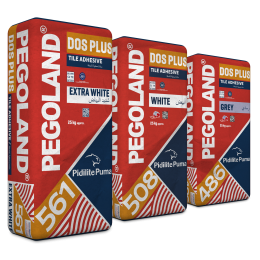
Cementitious adhesive for porcelain tiles, ceramic tiles and natural stones, made of mixed binders, fortified with polymers that provides high adherence, reduced slip and extended open time. Suitable for installing all types of tiles and natural stones over wide variety of substrates. Suitable for interior and exterior floor covering, interior wall covering and exterior baseboards. Suitable for tile over tile applications. Suitable for dry and wet areas.



Additional information
Technical Characteristics
One component poduct based on high-strength cement, selected aggregates, additives, and synthetic resins that guarantee superior bond strength , excellent workability and resistance to ageing.
Advantages and Uses
- Reduced slip, excellent initial adherence.
- Long open time, allows rectification.
- No need to wet tiles or substrates thanks to its high water-retention capacity.
- Adhesion of all types of ceramic tiles, porcelain stoneware, glass mosaic, marble, granite and other natural stone.
- Suitable for floors with underfloor heating.
- Suitable for tile over tile installations on internal floors.
- Suitable for swimming pools and other wet areas.
- Suitable for sidewalks with heavy traffic.
Suitable Substrates
- Conventional cement-based substrates.
- All types of plasterboard or drywall.
- Marble, granite, terrazzo, other natural stone and all types of ceramic substrates in interior floor and wall applications.
- Substrates must be resistant, stable and sound. They must be clean, and free of dust, laitance, remains of release agents, and organic compounds.
- All substrates must have a suitable flatness. If this is not the case, levelling can be performed up to 5 mm using the same adhesive, 48 hours prior to tile installation.
- For levelling over 5 mm thickness use:
- On floors: depending on the particular need, Paviland SL 10/ Paviland SL 10R, self levelling compounds, or a screed.
- On walls: mortars with adequate tensile strength with drying shrinkage already completed.
- For levelling over 5 mm thickness use:
- In case of extreme heat, hard wind or very absorbent substrates, it is recommended to moisten the substrate and wait for the water film to dissapear.
- On exterior pavement installations, the substrate must have a slope equal to, or greater than 1%.
- Avoid application on gypsum plaster, anhydrite or other substrates that may have a high sulphate content.
- Avoid contact with water with high sulphate content.
- All substrates must comply with the specifications in section 6.4 of the UNE 138002 standard.
Application Procedure
- Add water and mix manually or mechanically until a homogeneous and easy-to-work-with consistency is achieved.
- Let the mixture rest for 5 minutes and remix.
- Spread the mixed mortar on the substrate with a trowel to a maximum area of 2m².
- Comb the area with a notched trowel to adjust the thickness (see table).
- Place the tiles on the fresh adhesive, pressing and moving them until the ridges are fully flattened and the entire surface of the tile or stone adheres correctly.
- Periodically check the stickiness of the adhesive by lifting a tile. If you notice that skin has formed on the adhesive and the adhesive is no longer wet, remove the material and apply fresh product.
- Use the back-buttering / double gluing installation method for exterior applications, when laying tiles with a side exceeding 45 cm, for commercial or industrial flooring, when underfloor heating is present, when levelling systems are utilized, or when the tile or stone has surface relief that may hinder proper adhesive contact.
- Respect the joints between the tiles as indicated in section 7.7 of the UNE 138002 standard. In interiors and swimming pools, the joint width should be ≥ 1.5 - 3 mm, and in exteriors, the joint width should be ≥ 3 - 5 mm, depending on the type of installation and the size of the tile being laid.
- Joints should be grouted after 24 hours on walls and after 48 hours on floors. Use the appropiate Morcemcolor product for grouting, depending on the type of installation.
NOTE: The shorter the time between spreading the adhesive and laying the tile, the better the results that will be obtained.
Notched-trowel panel
| Tile's format | Larger side | Trowel to be used on the substrate | Trowel to be used on the back of the tile |
| Mosaic | ≤ 10 cm | V 3 | - |
| Ceramic Tiles | ≤ 20 cm | U 6 | - |
| ≤ 30 cm | U 6 | - | |
| ≤ 45 cm | U 8 | - | |
| ≥ 45 cm | U 8 | Smooth side of the trowel | |
| ≤ 120 cm | U 10 / R 10 | Smooth side of the trowel | |
| ≥ 120 cm | U 12 - R 12 | Smooth side of the trowel / V 3 / U 3 | |
| Large slab tiles >3 mm - ≤ 6 mm |
≤ 90 cm | U 6 | Smooth side of the trowel |
| ≤ 260 cm | U 8 | Smooth side of the trowel / V 3 / U 3 | |
| NOTE 1 - In the case of extruded tiles or tiles with a very pronounced reverse side, it is always necessary to use the double bonding method with the smooth side of the trowel irrespective of the tile format. | |||
Recommendations
- The longevity of the ceramic tile installation can only be ensured with proper planning. We therefore recommend consulting the national standards in force in each country, such as UNE 138002 in Spain. These standards outline specifications for material selection, proper planning, and installation, ensuring the achievement of the required levels of quality, performance, and durability.
- Application temperature range : from 5ºC to 40ºC.
- Avoid application when there is risk of frost, rain, strong winds or direct sunlight.
- Under extreme weather conditions, drying occurs faster than normal, and less adhesive should spread before placing tiles.
- Maximum weight on vertical surfaces: 40 kg/m².
- Avoid application on gypsum plaster or paint.
- Do not use the spot bonding technique.
- Temperature, ventilation, substrate absorption, and coating materials can vary the workability and setting times of the adhesive.
- Respect the movements joints (structural, contraction, expansion, and perimeter) as indicated in section 7.8 of the UNE 138002 standard. These joints should be treated by placing prefabricated movement profiles or by filling them with elastic, deformable sealant.
Dimensioning and sizing of expansion joints
| Application scope | Location and dimensions | Width of the joint mm |
| Exterior walls | - Under each floor slab. - Separation length 3 m - 4 m linear - Maximum regular area. 16 m2 |
≥ 8 mm |
| Interior floors | - Respect existing expansion joints. - Otherwise: linear separation lengths ≤ 8 m. - Maximum regular area. 40 m2 |
≥ 5 mm |
| Exterior floors | - Separation length 2.5 m - 5 m linear - Maximum regular area 16 m2 |
≥ 8 mm |
| Singular points | - Doorsteps - Changes of substrate. |
|
| NOTE When these expansion joints are positioned over structural joints, they must meet the requirements for structural joints. | ||
Dimensioning and sizing of perimeter joints
| Application scope | Location and dimensions | Width of the joint mm |
| Interior walls | - Perimeter joints - Wall /ceiling intersection |
≥ 8 mm |
| - Wall /wall intersection | ≥ 5 mm | |
| Exterior walls | - Interior corners of the building - Exterior corners of the building |
≥ 8 mm |
| Interior floors - Monolithic - Parquet |
- Perimeter joints and intersections with other elements or devices | |
| Exterior floors | - Perimeter joints and intersections with other elements or devices | |
| Singular points | - Intersection joints at encounters with carpentry | ≥ 5 mm |
- Refrigerated rooms must stay turned off until the adhesive has cured, at least 7 days depending on environmental conditions.
- Swimming pools can be refilled 7 days after the adhesive has been applied.
- Tile adhesives do not replace waterproof membranes in swimming pools or other wet areas.
- On floors with underfloor heating, apply when the substrate is at room temperature.
- Underfloor radiant heated floors must be turned off at least 48 hours before installation and the ignition must be carried out gradually after at least 7 days from the installation.
- In applications on laminated plasterboard walls, ensure the substrate is securely fixed to prevent movement.
- When tiling over existing tile flooring, remove the poorly adhered pieces and fill the gaps with adhesive the day before the applying the new tiles. Ensure that the old ceramic is free of grease or wax residue. If necessary, grind the old surface until the tiles or stones lose their shine. If in doubt, perform a preliminary test to determine the suitability of the application.
- When installing water sensitive or mesh reinforced stone or aggllomerate tile, contact the technical department to recommend the adhesive.
- Water-sensitive tiles that might stain or warp should be placed with a fast-setting adhesive, PEGOLAND FAST FLEX.
- For slate and thin porcelain slabs use PEGOLAND SUPERFLEX.
Packaging and Storage
25 kg plastic-lined paper bags
Shelf life: 1 year in sealed original packaging, sheltered from weather conditions and humidity.
Technical data
(Statistical data obtained under standard conditions)
| Appearance | Grey, White and Extrawhite powder |
| Mixing water ratio | Pegoland DOS PLUS Extrawhite: 24±1% |
| Pegoland DOS PLUS White: 24±1% | |
| Pegoland DOS PLUS Grey: 24±1% | |
| Adjustment time | Approx. 30 min. (depending on weather conditions) |
| Pot life | Approx. 2 hours (depending on weather conditions) |
| Service temperature | -30ºC a 90ºC |
| Approximate yield | Single gluing: 4 Kg/m2 |
| Double gluing: 6 Kg/m2 |
| Complies with | ANSI 118.4 | ||
| UNE-EN 12004 Classification | C2 TE | ||
| ISO 13007 Classification | C2 TE | ||
| According to EN 12004 and ISO 13007 | Specification | Results | |
| Tensile adhesive strength (28 day cure) | ≥ 1 N/mm2 | 1,5 - 2,2 | |
| Tensile adhesive strength heat ageing | ≥ 1 N/mm2 | 1,4 - 1,79 | |
| Tensile adhesive strength after water inmersion | ≥ 1 N/mm2 | 1,1 - 1,34 | |
| Tensile adhesive atrength open time 30 min | ≥ 0,5 N/mm2 | 1,2 - 1,5 | |
Notas
The information and instructions in this datasheet are based on our current tests and technical knowledge. They are intended as general guidance and do not constitute a binding commitment by PIDILITEPUMA MEA CHEMICALS LLC. It is the sole responsibility of the user to verify, prior to use, that the product is suitable for the intended application and to ensure that it is applied correctly and in accordance with applicable regulations and good industry practice.
PIDILITEPUMA MEA CHEMICALS LLC cannot control how its products are applied on site throughout the entire project and therefore cannot accept responsibility for their application by contractors or other parties involved in the execution of the work. Support visits to the jobsite by our technical staff do not change that. Our responsibility is limited exclusively to defects that can be directly attributed to the supplied products, whether used individually or as part of a system, caused by manufacturing defects.
It is the responsibility of the project designer, site manager, contractor, or other relevant professionals to ensure that the selected products are appropriate for the specific project, taking into account their properties, the substrate, site conditions, and any existing issues.
In the event of a claim, the original packaging must be provided to ensure proper product traceability.
Any performance values stated for PIDILITEPUMA MEA CHEMICALS LLC products or construction solutions, whether in UNE standards or other applicable standards, are based solely on the specific test conditions defined in those standards (such as substrate type, temperature, and humidity). These values may not apply to situations where products are tested or used under different conditions.
Documents
-
Technical data sheet
PIDILITE PUMA_flyer_Tiling Solutions
PIDILITE PUMA MEA - Company Brochure
PIDILITE PUMA MEA - Flyer Pegoland and Morcemcolor range
PIDILITE PUMA MEA - Adhesives and grouts for tiles and stones installation - Selection guide
PIDILITE PUMA MEA - Pegoland and Morcemcolor - Folded leaflet
Safety data sheet 24_01
DCL_Quality Mark
Systems using Pegoland® Dos Plus C2 TE

Drypool System
Swimming Pool Waterproofing and Tiling System
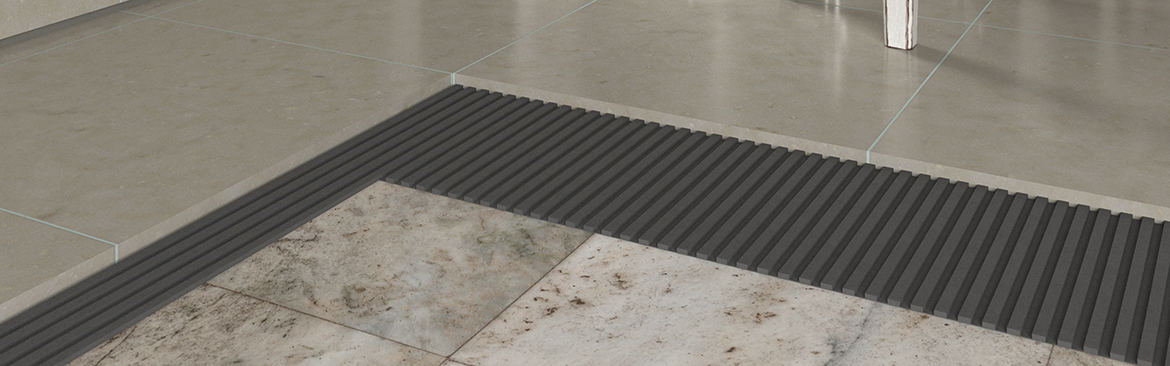
Tile on Tile installation
System for installingTile or Stone (new) on existing Tiled surface (old)