 Niveland® 30R
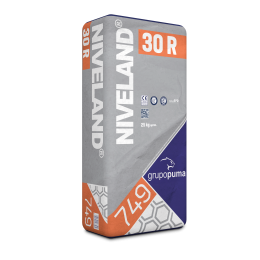
Self-levelling mortar for the preparation of interior floors, which, once it gets hard, it is suitable for any kind of floors (ceramic, wooden flooring, carpet, etc.) 2 to 30 mm thickness. Levelling mortar for interior irregular floors. High mechanical strength and excellent adhesion on cementitious and concrete mortars. This self-levelling mortar has a great workability and fast setting capacity.



Additional information
Technical Characteristics
Product based on special cements, selected aggregates, resins and additives.Advantages and Uses
- Levelling mortar for interior irregular floors.
- High mechanical strength and excellent adhesion on cementitious and concrete mortars.
- It can be manually applied or by pump.
- Great workability.
- Smoothing of floors in high pedestrian traffic floors: commercial premises, restaurants, cafés, hotels, etc.
- Suitable for finishes with ceramic, natural and artificial stone floors, etc.
- Ideal as a finishing layer before applying very thin coat such as carpet, vinyl, PVC, paints, etc.
- Fast-setting.
- Exceptionally smooth finish with strong surface.
- Compatible with radiant heating floors.
Suitable Substrates
- Concrete, cementitious floors, floors with a suitable resistances and others. Please consult our technical department for a different type of substrate.
- Substrates must be resistant enough, stable, sound, and clean. Free of dust, release agents, organic products, etc.
- If necessary, the substrate should be prepared by mechanical means, so to obtain a surface free of surface grout with a suitable porosity.
- Before applying NIVELAND 30R make sure all holes and / or cracks are previously repaired on the substrate by using products from our Niveland, Paviland or Morcemrest range, depending on the nature of the substrate and the type of repair required.
- Apply Paviland Primer R to avoid the formation of air bubbles in the render and improve its adhesion to the substrate.
- Before applying the paste, make sure that residual moisten is below the recommended one (below 3%).
Application Procedure
By pumping machine:
- A 2-stages mixing pump must be used adding water until getting the required fluidity.
- Spread the product with a levelling trowel until getting the required thickness.
Mechanical or manual mixing:
- Mix the product with water (6-6.5 litres per 25kg sacks) mechanically, with a mechanical mixer at low speed (500 rpm approximately) until getting a homogeneous paste without lumps. The exact water dosage is particularly important to avoid product segregation, high shrinkage, and reduction of strength.
- Let the paste rest around 2 min. then mix again.
- Pour the mixed product onto the collocation bottom and spread it with a levelling trowel until getting the required thickness.
- In both cases, it is recommended to use a spiked roller, of the appropriate size, vigorously in two directions to eliminate trapped air.
- Recommended maximum thickness is 2 to 30 mm single coat.
- Respect structural joints and create perimeter and partition joints.
- NIVELAND 30R should be protected as it is not a suitable material to remain uncovered.
Recommendations
- Do not apply below 5ºC and do not apply above 30ºC.
- Do not apply with risk of frost, strong winds or direct sun.
- Do not apply outdoors.
- Do not apply on soils with humidity or with risk of humidity.
- Use gloves and protective goggles for its use. Keep out of reach of children.
- Once the product has been kneaded and its resting time has elapsed, do not add additional water.
- For floors with surfaces of more than 20 m2 or more than 10m linear, it is recommended to make partition joints, delimiting panels, with joints of about 6 mm that can be filled with PUMALASTIC MS or PU.
- The movement joints of the original substrate should be respected and perimeter joints should be made.
- The surface layer must be protected from drying too quickly, especially in conditions of high temperature and/or strong wind.
- Before laying the final screed, the residual moisture content of the screed must be checked and checked to see if it is suitable for the type of screed to be installed.
- Due to the natural origin of the raw materials used, a uniform colour tone in the finish is not assured.
In radiant heating floors:
- The drying times of the screed must be respected before laying, at least 48 hours.
- The heating system should be switched on gradually increasing the temperature at intervals of 2-3 ºC until the operating temperature is reached. This should be done in stages over a period of 48 hours.
- The heating system should be turned off 48 hours before starting the laying work.
Packaging and Storage
25 kg plasticized paper sacks.
Storage up to 1 year in its original closed container, sheltered from weather and humidity.
Technical data
(Statistical results obtained under standard conditions).
| Aspect | Grey powder |
| Open time | 20 min |
| Adhesion | > 1.5 N/mm2 |
| Expansion-Shrinkage | < -0,3 mm/m |
| Time to be passable (*) | 2 hours |
| Time for sanding (*) | 4 hours |
| Time to render (*) | |
| Tile or carpet: | 6 hours |
| Wooden flooring or synthetic rendering: | 24 hours |
| Compressive strength of concrete. | |
| 6 hours | > 5 N/mm2 |
| 24 hours | > 15 N/mm2 |
| 28 days | > 30 N/mm2 |
| Approximate performance | 1,65-1,75 kg/m2 y thickness mm |
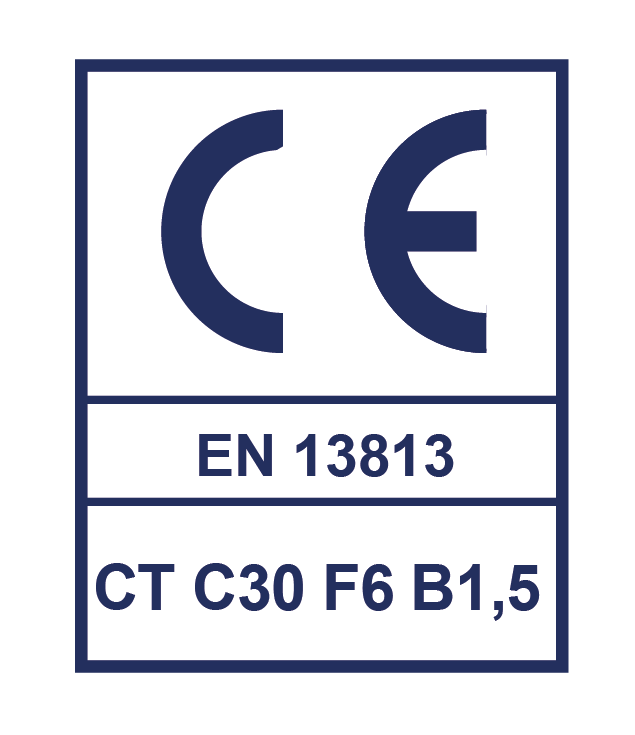
| Classification according to UNE- EN 13813 | CT C30 F6 B1,5 |
| Application thickness | 2 to 30 mm |
(*): The times refer to a temperature of 23ºC and 50 % relative humidity. They are shorter at higher temperatures and longer at lower temperatures.
CE Mark
 |
|
|
GRUPO PUMA ESPAÑA SL Avda. AGRUPACIÓN CÓRDOBA, 17 14014 CÓRDOBA |
|
|
NIVELAND 30R Nº: 501864-01 EN 13813 |
|
| Reaction to fire | Class A1 |
| Emission of corrosive substances | CT |
| Compressive strength | C30 |
| Flexural strength | F6 |
| Tensile Strength | B1.5 |
| See Safety Data Sheet | |
Environmental Product Declaration (EPD)
Mortar made with aggregates close to the production centers, reducing greenhouse gas emissions associated with their transport and produced in production centers with Environmental Management Systems certified in accordance with ISO 14001, a firm commitment to sustainability and respect for the environment. Mortar with ecological label type III (the most demanding) Environmental Product Declaration verified externally by AENOR.
Notas
The instructions for use are given according to our tests and knowledge and do not imply any commitment by GRUPO PUMA nor free the consumer from the examination and verification of the products for their correct use. Claims must be accompanied by the original packaging to allow a proper traceability.
GRUPO PUMA is not responsible, in any case, for the application of its products or constructive solutions carried out by the application company or other parties involved in the process and / or execution of the work, limiting the responsibility of GRUPO PUMA exclusively to the damages directly attributable to the supplied products, individually or integrated in systems, due to failures in their manufacturing process.
In any case, the drafter of the work project, the technical management or the person responsible for the work, or collaterally the application company or other parties involved in the process and / or execution of the work, must ensure the suitability of the products addressing the characteristics of them, as well as the conditions, support and possible pathologies of the work in question.
The values obtained by GRUPO PUMAS's products or its constructive solutions that, as the case may be, are determined by the EN standards or any other regulation that applies to it in each case refers exclusively to the conditions specifically stipulated in said regulation and that are referred to, among others, to certain characteristics of the support, humidity and temperature conditions, etc. without being them required in the tests obtained under different conditions, all in accordance with the relevant regulation.